
Appling County Court Records After Arrest
After an Appling County jail arrest, the first record is often a booking or jail docket entry. That record may list arrest charges, booking date, bond status, and custody status. It is not the same as a court case. The court record starts when a charging document is filed and the case is opened or updated in the court system. For felony and state criminal prosecutions in Appling County, the research file points to the Brunswick Judicial Circuit District Attorney as the prosecutor context.
The Barnes Street public-safety complex adds a local detail to the court pathway. The sheriff's legacy page says the complex includes a First Appearance Room and Judges/Solicitors Office. A first appearance can address rights, probable cause, bond, and next court steps. For current custody and booking detail, use Appling County jail inmate records. For booking photos, use the Appling County jail mugshots page. Court records after arrest focus on filed charges and case status.
Find Appling Court Records After Arrest
Georgia Courts eAccess lists Appling State and Appling Superior court links and states that users will be redirected to the provider's website and must have an account to search court records. The research file found that both Appling State and Superior route to PeachCourt. The PeachCourt landing page shows registration, login, civil and criminal eFiling, and court documents. No unauthenticated Appling case-search fields were visible in the research pass.
- Open Georgia Courts eAccess and locate Appling State or Appling Superior.
- Follow the redirect to PeachCourt and register or log in if access is required.
- Search with the defendant name, case number, or charge details available from the jail or court notice.
- Read the filed charges, charge status, hearing entries, bond orders, and disposition separately from the arrest booking record.
The Georgia Courts eAccess screenshot is useful because it shows Appling State and Superior in the statewide court-record access list.
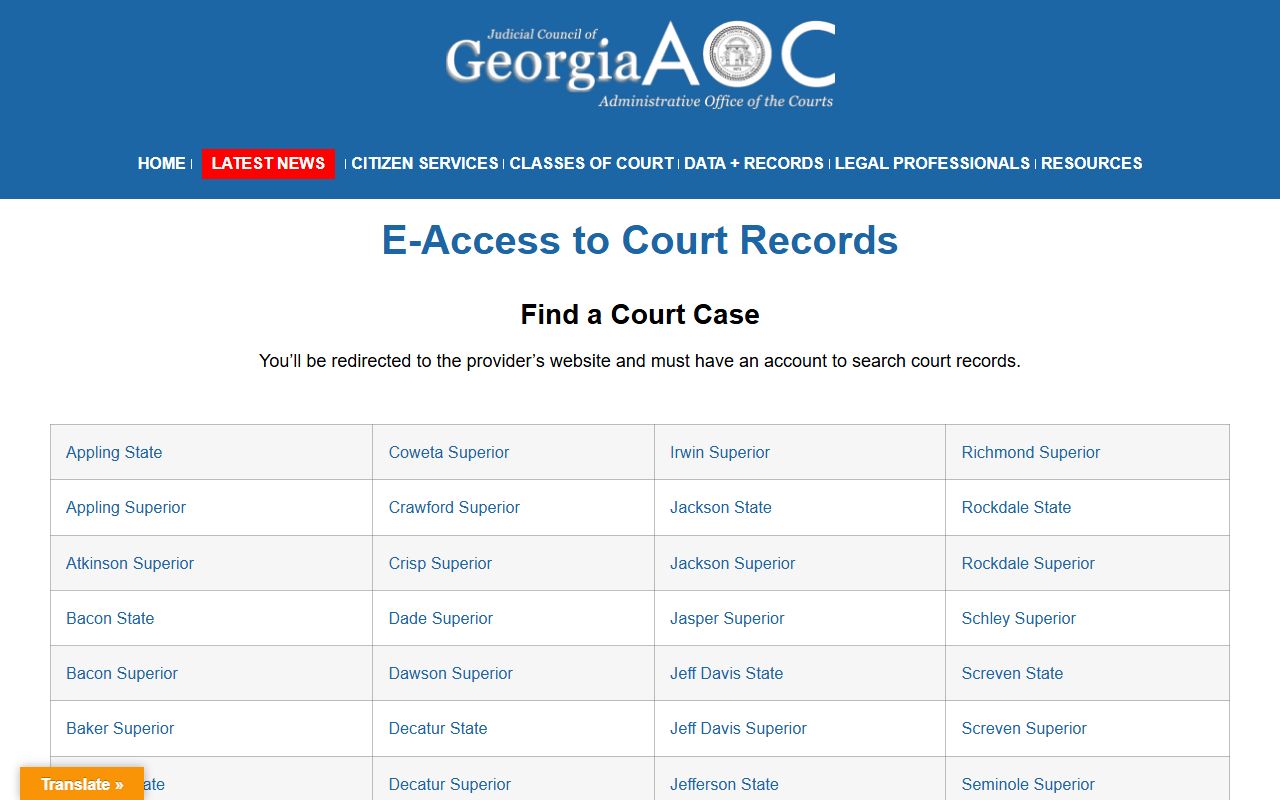
That screenshot ties the local court-record path to a statewide judicial access source rather than a jail roster or private listing.
Charges Filed After Appling Arrest
Booking charges can be entered by law enforcement at intake. Filed charges are reviewed and brought through the prosecutor and court. In Georgia practice, terms can include accusation or information for prosecutor-filed charges and indictment for grand jury charges, especially in felony matters. The exact document depends on charge type, court, and case posture.
| Document | Who Uses It | What It Means |
|---|---|---|
| Complaint | Law enforcement or prosecutor context | Initial allegation or charging record that can begin court action. |
| Accusation / Information | Prosecutor | Prosecutor-filed charge document used in many Georgia cases. |
| Indictment | Grand jury | Formal charge returned by a grand jury, generally for felony prosecution. |
Appling Charge Status Records
Charge status terms explain where a court record stands after a jail arrest. A charge may stay pending, be amended, be reduced, be dismissed, or be marked nolle prosequi. Nolle prosequi, often shortened to nolle pros, means the prosecutor declines to pursue that charge. These terms should not be read as the same thing as a booking hold or release status.
| Status | What It Means |
|---|---|
| Pending | The case or charge has not been disposed. |
| Amended | The charge changed from the original filing. |
| Reduced | The filed charge was lowered as part of prosecution or court action. |
| Dismissed | The charge ended without a conviction on that charge. |
| Nolle prosequi | The prosecutor declined to continue pursuing the charge. |
| Conviction | A final adjudication of guilt by plea, verdict, or other qualifying disposition. |
Bond After Appling Jail Arrest
Bond is part of the arrest-to-court path because it controls whether a person may leave jail while the court case continues. The Appling complex has a First Appearance Room, and first appearance can be where bond questions begin. The sheriff's OCV Jail Information menu also includes Approved Bonding Companies. The official list in the research file names T & M Bonding and Jail Break Bonding with published contact numbers, but the current list should be confirmed before payment.
| Bond Type | How It Works |
|---|---|
| Cash bond | Paid directly according to court or jail instructions. |
| Surety bond | Posted through an approved bonding company when allowed. |
| Property bond | May be available if the court approves qualifying property. |
| Personal recognizance | Release based on a court order and promise to appear. |
| No-bond or hold | Custody continues until court action or another agency hold clears. |
Note: A local bond may not produce release if a state, federal, ICE, probation, parole, or another-county detainer remains active.
Appling Warrants and Court Records
Warrants can lead to a jail arrest and later court records, but no active Appling warrant search form was found in official sources. The old sheriff page had a navigation reference to an active warrant list, but no content was located. The newer OCV Most Wanted feature says to check back later for updates. For a warrant question, call the Sheriff's Office at 912-367-8120 and ask which court or agency issued the warrant, whether bond is set, and what process applies.
Bench warrants may come from State, Superior, Magistrate, Municipal, or other courts. They may not appear on a sheriff web page even when a court record exists. Use Georgia Courts eAccess or PeachCourt where available for case context, and use the sheriff's Open Records Request form for releasable law-enforcement records. Active investigations and safety-sensitive records can be withheld or redacted under Georgia law.
Charges vs Convictions
An Appling County arrest charge is not proof of guilt. It is an allegation or booking entry connected to an arrest. A conviction is a later court result by plea, verdict, or other final adjudication. Court records after arrest may show both pending charges and final outcomes, so read the status line and disposition before drawing conclusions.
| Charge | Conviction | |
|---|---|---|
| Stage | Allegation or filed count | Final adjudication of guilt |
| Source | Jail booking, prosecutor filing, or court case | Court disposition |
| Can change? | Yes, it may be amended, reduced, or dismissed | Can be appealed or restricted only through legal processes |
Restricted Appling Arrest Records
Georgia uses the term record restriction for eligible criminal-history records. The research file cites Georgia.gov and the GBI/GCIC process for record restriction after eligible dispositions. A restricted record is not the same as a record erased from all government systems. It is a limit on public access under Georgia law. Court records, sheriff records, criminal-history records, and commercial search results may each require a different correction path.
| Restricted / Sealed | Expunged / Removed | |
|---|---|---|
| Georgia framing | Georgia commonly uses record restriction for eligible records. | True destruction or removal depends on the record type and law. |
| Public view | Access may be limited for qualifying records. | May no longer appear in a specific public source if removal is granted. |
| Route | Georgia.gov record restriction and GBI/GCIC instructions. | Originating agency, court, or source-specific correction process. |
Background Check Limits
Court records after a jail arrest are public-record resources, not a substitute for a compliant consumer background check. Employment, housing, credit, insurance, and similar screening decisions are regulated uses that require proper legal process and compliant providers. Public jail and court records can also be incomplete, delayed, amended, restricted, or misread if the charge status is ignored.
Important: Do not use jail, court, or custody information from this site for any FCRA-covered screening decision.
Limits on Appling Court Access
Georgia's Open Records Act and court-access rules do not make every record public in full. Juvenile records, sealed or restricted matters, medical details, safety-sensitive law-enforcement records, active investigation material, and certain personal data may be withheld or redacted. The sheriff handles law-enforcement and jail records. Courts and clerks handle case files. GDC handles state offender records. Matching the record to the correct office is often the fastest way to avoid a dead end.